Bitcoin Network Dominance
CASE FILE: BITCOIN NETWORK DOMINANCE
When the Protocol Changes — and the Narrative Stays the Same
I. You Cannot Steal Something and Call It the Original
Bitcoin was defined in a nine-page document:
Bitcoin: A Peer-to-Peer Electronic Cash System (2008)
https://bitcoin.org/bitcoin.pdf
The white paper does not describe:
Digital gold
Store of value only
Settlement layer only
Seven transactions per second
A layered banking stack
It describes:
Peer-to-peer electronic cash
Direct payments
Proof-of-work validation
Timestamped transaction chains
Economic incentives
If the white paper defines Bitcoin…
Then the white paper is the benchmark.
Not the ticker.
Not the exchange listing.
Not the ETF.
When a system diverges from its founding document — but keeps the brand — Confokulation™ begins.
II. The Protocol Split: BTC vs BSV
When Temporary Limits Become Permanent Doctrine
In Bitcoin’s early years, block size was not a philosophical boundary.
The 1MB limit was introduced in 2010 as a defensive mechanism against spam attacks. It was not presented as a permanent scaling ceiling. The assumption at the time was simple:
As hardware improves and bandwidth increases, block capacity can increase.
The white paper itself states:
“As long as honest nodes control the majority of CPU power…”
It does not say:
“As long as blocks remain permanently small.”
Bitcoin’s design was built around economic scaling through proof-of-work competition. Miners compete. Hardware improves. Capacity grows.
That is how networks scale.
In its early trajectory, Bitcoin was on a path where block size could increase gradually alongside hardware advancement — theoretically allowing transaction throughput to grow far beyond legacy payment networks.
Visa processes thousands of transactions per second.
Bitcoin was not architecturally limited to single-digit throughput by design.
It became limited by policy.
That distinction matters.
The 2015–2017 Scaling Debate
By 2015, the network began approaching the 1MB block ceiling.
Two camps formed:
One argued:
Increase block size.
Allow Layer-1 to scale.
Keep micro-transactions viable.
Let miners compete for volume.
The other argued:
Keep blocks small.
Preserve node decentralisation at low hardware cost.
Move scaling to second layers.
Prioritise security conservatism over throughput.
This debate was not minor.
It was existential.
Because scaling direction determines incentive structure.
2017: The Chain Split
In 2017, disagreement culminated in a split.
From that moment forward, two architectural philosophies crystallised.
BTC Philosophy
Restrict block size.
Maintain limited Layer-1 throughput.
Encourage Lightning and other Layer-2 solutions.
Reposition Bitcoin as “digital gold” or settlement layer.
The narrative shifted from:
“Peer-to-peer electronic cash”
to
“Store of value.”
That narrative shift was not in the white paper.
It emerged after throughput constraints became policy.
Small blocks created fee pressure.
Fee pressure priced out micro-transactions.
Micro-transaction loss weakened the electronic cash thesis.
Digital gold filled the vacuum.
This is incentive evolution.
(Doctrine IV — Incentives Always Win)
https://confokulated.com/post/incentives-always-win
BSV Philosophy
Restore original protocol functionality.
Remove artificial block limits.
Scale on Layer-1.
Preserve micro-payments and direct settlement.
BSV’s position is that Bitcoin’s competitive proof-of-work model only works economically if transaction volume scales.
In this model:
Miners earn through volume.
Fees remain low.
Micro-transactions remain viable.
Layer-2 becomes optional, not required.
Scaling happens where Bitcoin was designed to scale — at the base layer.
This Is Not Tribalism
This is not “my coin vs your coin.”
This is systems divergence.
One model says:
Security and decentralisation are preserved by constraining throughput and layering above it.
The other says:
Security and decentralisation are preserved by economic competition at scale.
These are mutually different economic futures.
The Subtle Confokulation™
The subtle diversion occurred when:
Temporary limits became permanent doctrine.
And the narrative shifted without most users noticing.
People were told:
“Bitcoin can’t scale.”
But that statement assumes a policy choice, not a protocol necessity.
If a network is intentionally constrained,
and then declared inherently limited,
that is narrative reframing.
When the public accepts:
“Bitcoin was never meant to scale,”
without re-examining the white paper,
Confokulation™ stabilises.
(Doctrine I — Outcomes Matter More Than Appearances)
https://confokulated.com/post/outcomes-matter-more-than-appearances
The Core Structural Question
If Bitcoin was introduced as peer-to-peer electronic cash…
And scaling decisions altered its base-layer capacity…
Then the real question is:
Was the protocol improved?
Or was its economic direction changed?
Because once direction changes,
incentives change.
Once incentives change,
the network evolves toward a different equilibrium.
And when equilibrium changes,
identity becomes debatable.
III. It Is on Record
Developers aligned with BTC have publicly acknowledged that significant portions of the original scripting capabilities and protocol surface were altered, disabled, or deprioritised over time.
The current BTC model prioritises:
Security conservatism
Small blocks
SegWit
Layer-2 reliance
If a system now supports less than the functional scope originally envisioned…
The question becomes:
Is it evolution — or deviation?
And if deviation occurs while the name remains…
That is narrative capture.
(See Doctrine I — Outcomes Matter More Than Appearances)
https://confokulated.com/post/outcomes-matter-more-than-appearances
IV. Commodity vs Currency
Why the Narrative Shift Changes Who Captures the Profits
Money historically emerges as a commodity:
Gold
Silver
Oil
Grain
A commodity is not decreed into existence.
It competes into existence.
It survives because:
It is scarce.
It is costly to produce.
It cannot be arbitrarily expanded.
It does not require an issuer.
Gold does not need permission to exist.
Oil does not need a board vote to validate it.
They are economically competitive assets.
Bitcoin’s Radical Design: A Digital Commodity
Bitcoin introduced something unprecedented:
A digital asset governed by proof-of-work competition.
Miners compete.
Nodes validate.
Energy is expended.
The longest chain with the most accumulated proof-of-work prevails.
No committee.
No issuance authority.
No monetary policy board.
That is commodity behaviour.
It earns legitimacy through competition — not decree.
And that matters.
Because commodities are difficult to control without custody.
Where Financial Engineering Begins
To build financial instruments, institutions require:
Custody
Aggregated liquidity
Clearing mechanisms
Counterparty structures
Settlement batching
Margin systems
Once custody concentrates, financialisation accelerates.
And financialisation is where the profit multiplies.
The Numbers Tell the Story
Let’s examine the scale of institutional monetisation in the BTC ecosystem.
Spot Bitcoin ETFs
As of 2024–2025, U.S. spot Bitcoin ETFs collectively manage tens of billions of dollars in assets.
If total AUM reaches $50 billion — and average management fees sit around 0.20%–0.30% — that produces:
$100 million to $150 million per year
in passive management fees.
Not trading profits.
Not leverage.
Just custodial management.
Recurring.
Annual.
Bitcoin Futures Markets
Bitcoin futures trade billions of dollars in daily volume across major exchanges.
Even conservative fee structures of 0.02%–0.05% on billions in daily volume produce:
Millions per day
in exchange revenue.
Derivatives generate:
Trading fees
Liquidation fees
Margin interest
Spread income
The volatility narrative is profitable.
Custodial Revenue
Major custodians charge:
Storage fees
Transaction fees
Institutional onboarding costs
Compliance services
Large institutions do not self-custody.
They outsource custody.
Outsourcing creates margin.
Lending and Yield Products
Layered financial structures introduce:
Bitcoin-backed loans
Structured yield products
Collateralised lending
Rehypothecation risk
Every layer creates:
Spread.
And spread is profit.
Why a Layered Currency Stack Is Attractive
If Bitcoin behaves as:
A reserve asset
A settlement layer
A digital gold instrument
Then activity concentrates in:
Exchanges
Custodians
ETF issuers
Clearing houses
Derivative markets
That concentration allows:
Product creation.
Leverage creation.
Synthetic exposure.
Instrument stacking.
Financial institutions thrive on layered structures.
Layered structures require:
Intermediaries.
What Happens If Bitcoin Scales on Layer-1?
If a Bitcoin network supports:
Massive transaction throughput
Micro-fees
Direct peer-to-peer usage
On-chain micro-payments
Data transactions
Then users transact directly.
When users transact directly:
Custodial dependency decreases.
Settlement batching decreases.
Intermediary spread shrinks.
Derivative reliance weakens.
A true digital commodity at scale reduces financial extraction surfaces.
That is the economic tension.
Commodity Model vs Currency Model
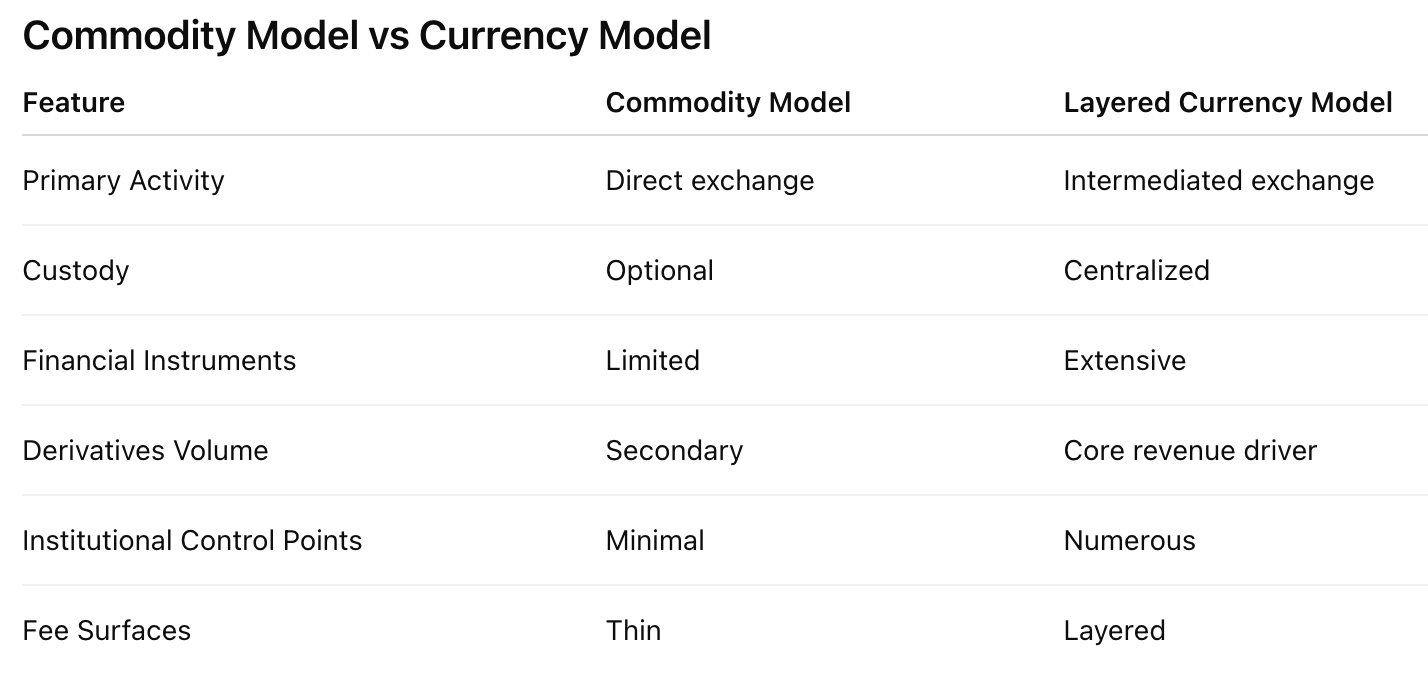
The more an asset behaves like a currency stack,
the more financial instruments can be built on top.
And instruments multiply profit.
The Incentive Gravity
This is not about villains.
It is about incentive alignment.
If a system can generate:
ETF fees
Futures volume
Options markets
Custodial income
Lending spread
Structured derivatives
Then capital will favour that structure.
If a system minimises:
Custody
Intermediation
Synthetic leverage
Then institutional profit margins shrink.
(Doctrine IV — Incentives Always Win)
https://confokulated.com/post/incentives-always-win
Why the Narrative Matters
Reframing Bitcoin from:
“Peer-to-peer electronic cash”
to
“Digital gold settlement layer”
does not just change language.
It changes:
Fee structures
Market architecture
Control surfaces
Profit potential
A scalable Layer-1 commodity reduces dependency.
A layered reserve asset increases dependency.
Dependency generates profit.
Profit reinforces narrative.
Narrative stabilises dominance.
That is systemic gravity.
The Structural Question
If Bitcoin remains a competitive digital commodity at scale,
who loses the ability to extract layered margins?
If Bitcoin becomes a layered financial reserve asset,
who benefits?
The debate is not technical.
It is economic.
And economics always reveals alignment.
V. The Layer-2 Control Surface
BTC’s base layer supports limited throughput.
That limitation is not debated — it is measurable.
The solution offered is Lightning Network.
Lightning is innovative.
Lightning works.
But Lightning introduces:
Channel dependency
Liquidity routing
Hub formation
Custodial reliance for user simplicity
When the base layer cannot scale,
users are pushed upward into layers.
And layers are where control accumulates.
If Layer-1 cannot carry global transaction volume,
Layer-2 becomes gatekeeper.
If BSV can scale at Layer-1,
Layer-2 becomes optional.
Optional layers reduce dependency.
Dependency reduction weakens institutional leverage.
That is the economic difference.
VII. Synthetic Supply, Leverage & Miner Economics
How 21 Million Can Become Financially Larger Than 21 Million
Bitcoin’s base protocol enforces a maximum issuance of 21 million coins.
That limit is mathematical.
It cannot be altered without consensus.
At protocol level, supply is capped.
But financial systems do not operate only at protocol level.
They operate at balance-sheet level.
And balance sheets can multiply exposure far beyond base-layer supply.
Fiat Parallel: How Supply Multiplies Without Printing
In fiat banking:
If $1 million is deposited in a bank,
the bank does not leave it idle.
It lends against it.
That loan becomes a deposit elsewhere.
Which becomes collateral again.
The monetary base stays constant —
but claims on that base multiply.
This is how credit expansion works.
The same structural mechanism can occur with Bitcoin — without changing the 21 million cap.
How Synthetic Bitcoin Exposure Is Created
When BTC is held in custodial structures:
Exchanges
ETFs
Lending platforms
Derivative desks
Margin trading systems
What users often hold is not on-chain BTC.
They hold:
Account balances.
Those balances represent claims on BTC.
Not direct control of UTXOs.
If an exchange holds 100,000 BTC,
it can theoretically support:
Margin trading exposure
Futures contracts
Options contracts
Lending products
Structured yield products
That represent multiples of that 100,000 BTC.
The base layer still shows 100,000 BTC.
But the financial system may have created:
300,000 BTC of exposure.
Or 500,000.
Or more.
This is synthetic supply.
Derivatives and Synthetic Expansion
Bitcoin futures and perpetual swaps trade billions in daily notional volume.
Notional volume often exceeds physical settlement.
When leverage is involved (5x, 10x, 20x):
A single BTC can support multiple leveraged positions.
Liquidation cascades prove this dynamic.
Price moves are amplified by leverage,
not just by physical coin movement.
This is structurally identical to:
Fiat credit expansion.
The protocol cap remains 21 million.
But the economic exposure exceeds it.
Why Layered Architecture Enables This
Synthetic multiplication requires:
Custody.
Centralised margin engines.
Clearing houses.
Settlement batching.
It cannot happen easily in a pure peer-to-peer commodity model
where users hold and transact directly on-chain.
In a high-volume Layer-1 model:
Transactions settle directly.
Custody remains optional.
Leverage is harder to centralize.
Balance-sheet multiplication is constrained.
In a layered currency stack:
Custody concentrates.
Internal ledgers expand.
Leverage multiplies.
Derivatives flourish.
Layering creates abstraction.
Abstraction enables multiplication.
Multiplication creates profit.
Miner Economics Comparison
This is where the divergence becomes profound.
BTC Model
Small blocks.
Higher fees during congestion.
Layer-2 scaling.
Derivatives dominate activity.
Miner revenue relies increasingly on:
Fee spikes
Subsidy (which halves every 4 years)
Institutional activity cycles
If the majority of economic volume occurs off-chain,
miner fee revenue depends on:
Settlement batching.
Channel openings.
Large transfer events.
Not micro-transactions.
BSV Model
Large blocks.
High transaction throughput.
Low fees.
Volume-based miner economics.
Miner revenue is designed to scale through:
Mass transaction volume.
Millions or billions of micro-fee transactions
generate predictable revenue.
This model does not depend on leverage cycles.
It depends on utility.
The Structural Risk of Synthetic Supply
When synthetic exposure grows beyond physical supply:
Price volatility increases.
Liquidation cascades intensify.
Market structure becomes fragile.
We saw similar fragility in:
2008 mortgage derivatives
Commodity futures leverage cycles
Banking credit expansions
When exposure exceeds underlying asset liquidity,
stability becomes dependent on clearing structures.
And clearing structures require control.
Why This Matters for the 21 Million Narrative
The public hears:
“There will only ever be 21 million Bitcoin.”
True — at protocol level.
But if financial exposure equals:
40 million.
60 million.
100 million BTC equivalent claims.
Then scarcity is diluted economically.
Not technically.
This is how fiat systems expand:
Not by printing physical notes alone,
but by expanding claims.
If Bitcoin becomes a layered financial reserve asset,
the same dynamics can emerge.
Not by changing the cap.
But by multiplying claims.
Incentive Gravity Again
Which structure generates more institutional revenue?
A pure, high-volume peer-to-peer commodity system?
Or
A layered reserve asset system with:
ETFs
Futures
Options
Lending
Margin
Synthetic leverage
The answer is not ideological.
It is mathematical.
Layered systems generate more fee surfaces.
(Doctrine IV — Incentives Always Win)
https://confokulated.com/post/incentives-always-win
The Core Structural Question
If Bitcoin scales directly on Layer-1:
Synthetic multiplication becomes harder.
Custodial dominance weakens.
Derivative leverage shrinks relative to utility.
Miner revenue depends on volume, not volatility.
If Bitcoin remains constrained and layered:
Custody concentrates.
Leverage multiplies.
Synthetic exposure grows.
Profit centralizes.
Which model aligns more closely with:
“Peer-to-peer electronic cash”?
Which model resembles modern fiat financial architecture?
That is the Confokulation™ pivot.
VII. The Legacy Address Myth — and the Deeper Truth
Protocol Stability, Business Risk & “Set in Stone”
Addresses starting with “1” are legacy P2PKH addresses.
Addresses starting with “3” are P2SH.
Addresses starting with “bc1” are SegWit formats.
Address prefixes alone do not determine legitimacy.
What determines legitimacy is:
Protocol rules
Scripting capability
Scaling behaviour
Incentive structure
Backward compatibility
The deeper issue is not the prefix.
The deeper issue is this:
Can a business safely build on Layer-1 without fearing that the rules will change?
The Business Layer Question
Imagine building a real business on Bitcoin Layer-1.
You invest in:
Infrastructure
Payment integration
Smart contract logic
Token issuance
Data recording
Automated settlement
API architecture
Merchant onboarding
Your revenue model depends on:
Protocol behaviour.
Now ask:
If the protocol changes — do you have to change your business model?
If opcodes are disabled…
If block limits are altered…
If transaction structure changes…
If scaling direction shifts…
Then yes.
You must adapt.
And adaptation costs capital.
BTC, BCH, BSV: Same Origin — Different Protocol Paths
All three chains share historical origin.
But they do not share identical rule sets today.
BTC implemented:
SegWit
Taproot
Script modifications
Constrained block policy
BCH diverged with larger blocks but altered other parameters.
BSV pursued restoration of earlier rule sets and expanded block policy.
A business built for one environment does not automatically port cleanly to another.
Even small rule differences can break:
Transaction validation assumptions
Script behaviour
Fee economics
Throughput expectations
You cannot run the exact same Layer-1 business seamlessly across all three.
They are not identical execution environments anymore.
That is architectural divergence.
Protocol Drift Has Consequences
If a protocol evolves frequently,
business risk increases.
Why?
Because business investment requires predictability.
Companies need:
Stable APIs
Stable script behaviour
Stable fee economics
Stable transaction formats
If the foundation shifts,
enterprise adoption slows.
Large-scale business prefers:
Infrastructure that behaves like concrete,
not sand.
“Set in Stone” — Why It Matters
The concept often attributed to Satoshi — that the protocol should eventually be “set in stone” — reflects a key engineering principle:
Foundational layers should stabilise.
The internet protocol (TCP/IP) does not change radically every few years.
HTTP stabilised.
Email protocols stabilised.
DNS stabilised.
Innovation happens on top —
not by constantly altering the base rules.
Why?
Because businesses need certainty.
If Bitcoin’s base layer constantly shifts direction,
Layer-1 becomes speculative territory.
If Bitcoin’s base layer stabilises,
Layer-1 becomes infrastructure.
There is a massive difference.
Commodity Infrastructure vs Experimental Stack
A commodity-like digital base layer must behave like:
Digital bedrock.
Predictable.
Consistent.
Reliable.
Backward compatible.
If the protocol is fluid,
the asset behaves more like a software experiment.
Financial institutions can tolerate experimental stacks —
because they build abstraction layers above them.
But businesses building directly on-chain need stability.
Why This Connects to Section IV (Commodity vs Currency)
A layered financial stack does not require strict base-layer stability for businesses.
Why?
Because most users are not building on Layer-1.
They are building:
On exchanges
On custodial APIs
On ETF wrappers
On derivative markets
Those layers can adapt internally to protocol changes.
But a true Layer-1 business cannot.
This is where incentive gravity reappears.
If the dominant economic activity shifts upward into custodial and derivative layers,
protocol drift affects fewer economic actors directly.
Layer-1 becomes:
Settlement infrastructure.
Not business infrastructure.
But if Layer-1 is the business layer —
then protocol stability becomes critical.
Can You Run the Same Business on BTC, BCH, and BSV?
Not identically.
Because:
Fee markets differ.
Block policies differ.
Script behaviour differs.
Throughput assumptions differ.
Node policies differ.
If you design for high-throughput micro-fees,
BTC’s constrained environment changes your economics.
If you design for small-block scarcity economics,
BSV’s high-volume model changes your assumptions.
Protocol direction defines business viability.
The Deeper Truth Behind the “Legacy Address” Debate
The prefix is irrelevant.
The protocol behaviour is everything.
If the protocol diverges from its original economic design,
and the brand remains unchanged,
Confokulation™ stabilises.
Users focus on:
Ticker symbols.
While ignoring:
Rule changes.
The Structural Question
If Bitcoin was introduced as peer-to-peer electronic cash…
And a business builds directly on Layer-1…
Should that business be confident that:
Transaction structure will remain predictable?
Script rules will remain usable?
Scaling direction will remain consistent?
Economic incentives will remain aligned?
If the answer is uncertain,
Layer-1 becomes fragile.
If the answer is stable,
Layer-1 becomes infrastructure.
That is not ideological.
That is enterprise reality.
Final Structural Insight
When protocol changes alter economic behaviour,
business risk increases.
When business risk increases,
capital prefers abstraction layers.
When abstraction layers grow,
intermediaries gain power.
And when intermediaries gain power,
the system begins to resemble the very structure Bitcoin was meant to transcend.
When behaviour diverges but branding remains,
Confokulation™ is stabilised.
VIII. Exchange Dominance, Token Proliferation & Institutional Advantage
As of recent counts, there are tens of thousands of digital assets listed across data aggregators — estimates range from 25,000 to over 30,000 tokens depending on classification.
This number alone reveals something structural.
Because if Bitcoin were functioning as a fully scalable global Layer-1 utility, the economic necessity for such fragmentation would be radically different.
Why Fragmentation Explodes in Constrained Systems
When a base layer is constrained:
Throughput is limited.
Fees fluctuate.
Script functionality is restricted.
Micro-transactions become uneconomical.
On-chain data use becomes expensive.
Developers who want:
Smart contract flexibility
Token issuance
High throughput
Low fees
Application-level functionality
must look elsewhere.
So they create:
New chains.
New tokens.
New Layer-1 experiments.
Each promising to “fix” a limitation.
Constraint produces fragmentation.
Fragmentation produces token proliferation.
Token proliferation produces speculative markets.
And speculative markets produce exchange revenue.
Exchanges Thrive on Fragmentation
Exchanges generate revenue from:
Listing fees
Trading fees
Margin interest
Futures and derivatives
Liquidation cascades
Spread arbitrage
The more tokens exist:
The more pairs exist.
The more volume exists.
The more volatility exists.
The more fees are generated.
A fragmented ecosystem multiplies monetisation surfaces.
This is not accusation.
It is market structure.
What Happens in a Scalable Layer-1 Model?
If a single base layer can support:
Massive transaction throughput
Tokenisation
Data storage
Smart contracts
Micro-payments
Enterprise integration
Then many separate tokens become redundant.
Not because they are “bad.”
But because they are unnecessary.
If one protocol can handle:
Payments + Tokens + Contracts + Data + Micropayments
on a single scalable ledger,
Then developers do not need to spin up thousands of alternative infrastructures.
Fragmentation decreases.
Speculative issuance decreases.
Intermediary arbitrage decreases.
Token Proliferation and Retail Risk
In highly fragmented ecosystems:
Retail participants face:
Information asymmetry
Volatility exposure
Low-liquidity traps
Pump-and-dump dynamics
Rug-pull risk
When thousands of tokens compete for attention,
most will fail.
That is statistical inevitability.
Exchanges profit from volume,
not long-term viability.
Developers may profit from issuance,
not sustainability.
Retail participants often absorb downside.
Again — this is not moral condemnation.
It is incentive alignment.
(Doctrine IV — Incentives Always Win)
https://confokulated.com/post/incentives-always-win
How Layer-1 Constraint Reinforces Exchange Power
If Bitcoin is constrained at Layer-1:
Exchanges become essential:
On-ramps
Off-ramps
Custodians
Clearing houses
Token marketplaces
If Bitcoin scales at Layer-1:
Direct usage increases.
Direct usage reduces:
Custodial necessity
Settlement batching
Off-chain dependence
Cross-token fragmentation
Exchanges may not disappear.
But their structural leverage diminishes.
Because users transact directly on-chain,
not through abstracted internal balances.
Institutional Incentive Alignment
A fragmented token ecosystem benefits:
Exchanges (volume & listings)
Market makers (spread capture)
Derivative desks (volatility monetisation)
Launch platforms (issuance fees)
Venture funds (early-stage allocation)
A unified, scalable commodity-like Layer-1 benefits:
Direct peer-to-peer commerce
Low-fee micro-transactions
Enterprise data settlement
Stable application development
One model maximises financial engineering.
The other maximises base-layer utility.
The Confokulation™
The public is told:
“Crypto innovation is exploding.”
Rarely are they asked:
Why does innovation require 30,000 separate tokens?
Is fragmentation a sign of necessity?
Or a sign of architectural constraint?
If a single scalable protocol can handle global demand,
then thousands of parallel tokens represent duplication of infrastructure —
and multiplication of speculative risk.
When constraint produces fragmentation,
and fragmentation produces fee surfaces,
dominant players have little incentive to reduce fragmentation.
(Doctrine V — Institutional Immunity)
https://confokulated.com/post/institutional-immunity-why-systems-survive-failure
Structural Shift
If Layer-1 scales:
Fewer chains are needed.
Fewer speculative tokens are necessary.
Exchange leverage compresses.
Retail exposure to low-liquidity assets declines.
If Layer-1 remains constrained:
Fragmentation persists.
Tokens multiply.
Volume increases.
Fee extraction expands.
The debate is not about which coin is “cool.”
It is about which structure reduces unnecessary fragmentation —
and which structure profits from it.
IX. Proof-of-Skill: The 1 Cent → 1 BSV → $1,000,000 Challenge
Theory is weak without measurement.
So here is measurable reality.
IX. Proof-of-Skill & Utility Economics
You Determine the Value — Not the Market
Speculation asks:
“What will the market pay?”
Utility asks:
“What can I build?”
The white paper does not describe Bitcoin as “digital gold.”
It describes:
A peer-to-peer electronic cash system.
The power is not in holding it.
The power is in circulating it.
Live Proof-of-Skill Snapshot (Day 142)
Initial Holding: 1 BSV
Total Supply: 100,000,000 sats
Miner Fees Spent: 131,170 sats
Remaining Balance: 99,868,830 sats
Current Portfolio Value: $35,684.50
ZAR Value: R 609,064.79
Time Elapsed: 103 days
Total miner fees represent:
0.13117% of total supply used.
This is not narrative.
This is measurable fee economics.
If Layer-1 can support sustained activity with negligible fee erosion,
the scale thesis strengthens.
(Doctrine III — Growth Without Measurement Is Hope)
https://confokulated.com/post/growth-without-measurement-is-hope
What This Actually Demonstrates
In 103 days:
Only 0.13117% of the total coin was consumed in miner fees.
The network supported continuous transactional activity.
The coin remained operationally intact.
That means:
The cost of using the network is economically negligible relative to asset size.
Which means:
The network can be used as infrastructure — not just held as a store of value.
The Real Insight
Most people believe:
“The market determines the value of Bitcoin.”
That is only true in speculative frameworks.
In a utility framework:
You determine the value of the coin
by what you can produce with it.
If 1 BSV enables:
Micro-payments
On-chain data storage
Token issuance
Settlement services
API monetisation
Business automation
Streaming payments
Machine-to-machine transactions
Then its value is not its exchange price.
Its value becomes:
The economic output generated per sat deployed.
From Speculation to Production
Speculation produces:
Volatility.
Emotion.
Cycles.
Utility produces:
Cash flow.
Services.
Revenue.
Infrastructure.
If a satoshi can be deployed repeatedly
with negligible fee cost,
then it becomes a micro-economic engine.
Not a lottery ticket.
What Is a Satoshi Worth?
There are 100,000,000 sats in 1 BSV.
If each sat is used:
To process a micro-transaction,
To trigger a contract,
To record business data,
To enable settlement,
To monetise API calls,
then the value of 1 BSV is not static.
It becomes dynamic.
Its value equals:
The total economic output generated by its circulation.
Market Price vs Productive Value
The market price reflects:
Supply and demand of holding.
Productive value reflects:
Supply and demand of using.
Gold sits in vaults.
Oil flows through pipelines.
Bitcoin, as designed, was meant to flow.
A flowing asset can compound value
without being sold.
That is different from speculative appreciation.
The Compound Utility Effect
If 1 BSV enables:
10,000 micro-transactions per day
Each generating $0.01 of economic output
Over 365 days
That is $36,500 in annual transactional output.
That number is hypothetical.
But the principle is not.
Value scales with utility.
Not with belief.
Why This Aligns with the White Paper
The white paper does not describe:
“Hold and wait.”
It describes:
Send.
Receive.
Verify.
Timestamp.
Settle.
The power of Bitcoin is not in scarcity alone.
It is in:
Low-friction, trust-less transfer.
If the network allows continuous micro-economic flow
with negligible friction,
then the coin becomes:
Economic infrastructure.
The Shift in Perspective
If you treat Bitcoin as:
Digital gold → You wait for price.
If you treat Bitcoin as:
Digital utility → You build.
The market cannot suppress productive value.
Because productive value is internal.
It does not require external price validation.
The Proof-of-Skill Principle
The 1 BSV challenge demonstrates:
You can use the coin
without eroding it.
You can circulate it
without losing it.
You can deploy it
without destroying its economic core.
That is commodity behaviour.
Not consumable currency behaviour.
The Structural Insight
If a coin is usable at scale:
Its value increases with skill.
Not hype.
If it is constrained and layered:
Its value depends more heavily on speculation and derivative markets.
One model says:
“Wait for appreciation.”
The other says:
“Create appreciation through output.”
Final Economic Reality
The market sets price.
You set productivity.
Productivity compounds.
Speculation oscillates.
If each satoshi becomes a micro-economic engine,
its true value is not its exchange rate.
Its true value is:
The economic output per sat deployed.
That is how value is added.
Not through narrative.
Through utility.
X. The Real Question
This Case File is not asking:
Which coin is cooler?
It is asking:
If the original design described peer-to-peer electronic cash…
And one branch restricts throughput and leans on layers…
And another branch restores base-layer scale…
Which aligns more closely with the white paper?
If deviation occurs but branding remains unchanged…
Is that innovation?
Or is that Confokulation™?
Final Doctrinal Mic-Drop
You cannot take a protocol,
alter its functional capacity,
limit its throughput,
redirect its architecture,
redefine its purpose,
and still claim identity without scrutiny.
If the white paper defines Bitcoin,
then alignment with the white paper matters.
Dominance is not price.
Dominance is not ETF approval.
Dominance is not ticker symbol.
Dominance is utility at scale.
And utility at scale removes dependency.
When dependency is removed,
control weakens.
That is why this debate is not technical.
It is structural.
And structural shifts are never neutral.
